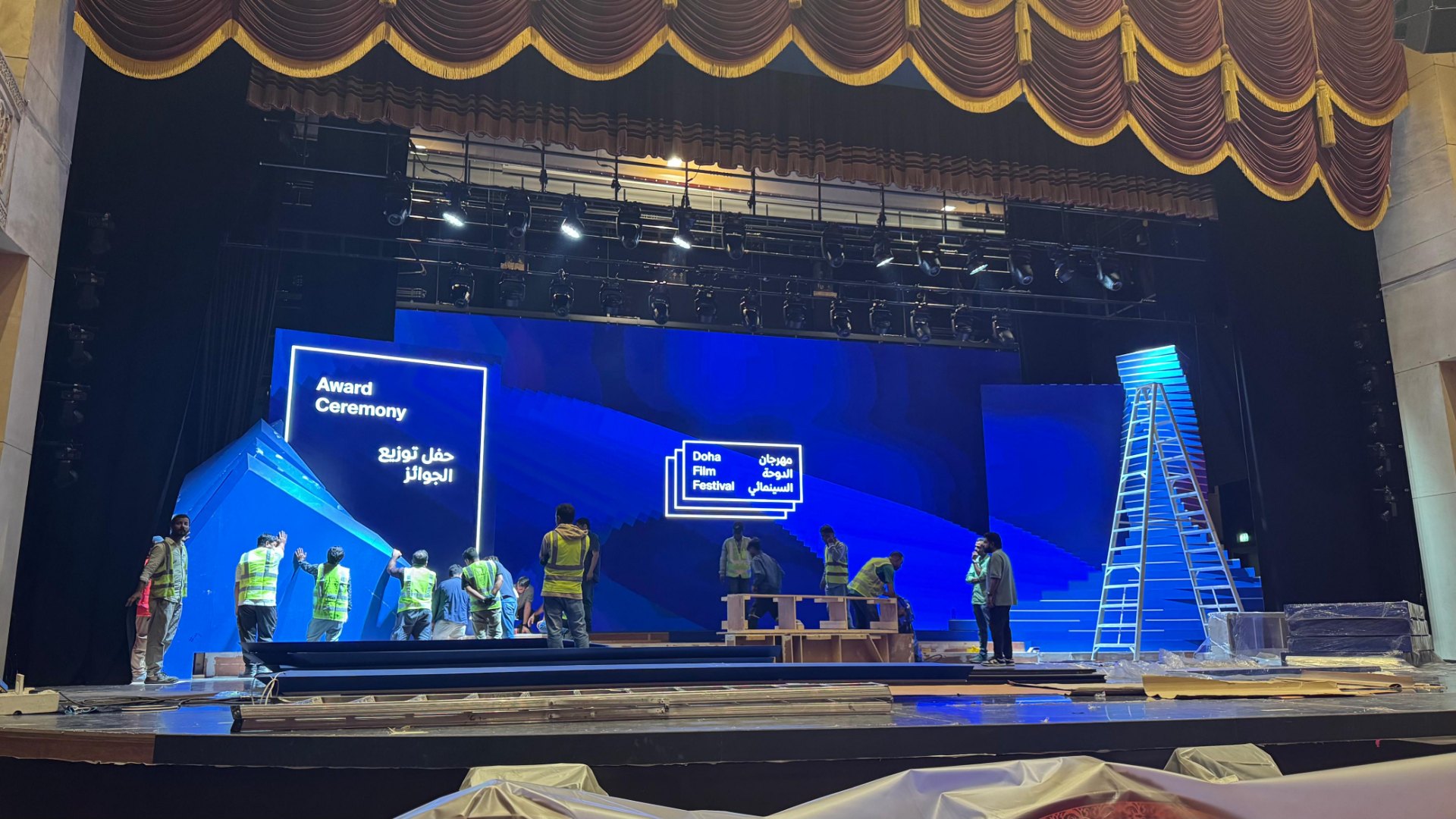
We were the only contractor on site running ahead of schedule.
It very nearly did not matter.
That is the part of event delivery that never makes it into a proposal. You can run your own scope perfectly, hit every date you own, and still end up exposed, because the thing that delays you is usually not inside your control.
The assignment
Doha Film Festival 2025. A one-month production management contract across Katara.
The shape of it:
Eight venues, two of which were built twice, once for the opening ceremony and again for the closing
Eleven days of build, nine show days, a day and a half of derig
An opening ceremony, screenings running across five screens, an awards night and a closing ceremony
Our client was the festival's AV supplier. We held the contract to project manage their delivery: sound, lighting, video, rigging and trussing. Five disciplines, arriving in the right order, in eight places, against a date that does not move for anybody.
This was never an equipment job
The kit was capable. Every discipline knew its own work and did it well. If you had audited any single team in isolation, on any given day, you would have found nothing wrong.
Event AV runs on sequence. Trussing goes up before lighting can be hung. Rigging has to be signed off before anything heavy goes on it. Video needs its positions confirmed before it can focus. Sound needs the room in something close to its final state before it can be tuned. Each team is waiting on the one before it, and each one has its own crew, its own kit and its own schedule.
Multiply that by eight venues. Then add two venues that had to be struck and rebuilt to a completely different specification between the opening and the closing.
The job was never the equipment. The job was the order.
The thing that nearly went wrong
Not the AV.
Our work sat downstream of other trades on site. Until their build was complete in a given space, our teams could not get in to do theirs. That is an ordinary dependency and on most projects it resolves itself.
On this one it did not. Two of the trades ahead of us ran behind schedule, and separately, delays to power meant we could not test equipment or run trials when we had planned to.
None of that was inside our scope. All of it was about to become our problem. The opening date had not moved. Our own work was ahead of programme. We simply could not get into the spaces, or energise what we had built, in the sequence the schedule depended on.
There was no version of this we could solve on our own. We held no contract with those trades, and we could not compress eleven days of build enough to absorb someone else's slip.
So we raised it with the client early, before it became a crisis, and set out plainly what it meant: which spaces were affected, which teams could not start, and what the consequence would be if the other trades did not accelerate. The client had the relationship and the authority that we did not. They took it up, and the other trades were pushed to expedite.
That is what unblocked it. Not a technical fix, not more people on our side. One conversation with the right person, early enough to matter.
Being ahead of schedule was not enough
This is the part worth sitting with, because it runs against how most people think about delivery risk.
We were ahead. Every discipline we were responsible for was on or ahead of programme. By any measure of our own scope, the job was going well.
And it made almost no difference, because the risk was never inside our scope. It was in the dependencies running between our work and everyone else's, where nobody is specifically responsible for looking.
Running your own scope well protects you from one category of failure. It does nothing at all about the other one. On a job with a fixed public date, the second category is the one that hurts.
What coordination actually is
Not a title. Not a weekly meeting. A specific, unglamorous discipline that looks like almost nothing from the outside:
Knowing which venue is being turned around, and exactly when
Knowing which team is waiting on whom, before either of them has to ask
Knowing what happens three steps downstream when something slips one step upstream
Knowing which of those slips is somebody else's to fix, and escalating it while there is still time for the fix to work
That last one is the difference between reporting a problem and preventing one. Anybody can raise a delay on the day it bites. The value is in seeing it while it is still four days away and somebody still has room to act.
What this is worth if you are paying for it
When coordination is missing, the cost never appears as a line item. It appears as a late start, a scrambled fix mid-event, one supplier blaming another while the client is the one standing in front of an audience. Nobody invoices for that, and everybody remembers it.
It is also the part of a multi-discipline project nobody budgets for, because it does not look like a deliverable until the day it turns out to be the only thing that mattered.
The same problem, in every fit-out
Swap festival venues for floors, and this is every corporate project that has ever run late.
AV has its schedule. IT has its schedule. The interior contractor has its schedule. Base build has its schedule.
Each one is coordinating their own scope perfectly well. Nobody is holding the seam between them. That seam is where budgets get eaten, where handover dates slide quietly by a week, then two, then a month, and where the room that was supposed to work on the day simply does not.
The lesson from Katara is not really about film festivals. It is about any project with more than one trade and a date that is not moving. Which, in practice, is most of them.
Closing
On the day, coordination beats equipment. It is the least glamorous thing we sell and the one clients thank us for afterwards.
Doha Film Festival 2025 was an AVYA assignment: production management across all festival locations in Katara. Unlike the other project articles in this series, this was AVYA's own work rather than a project delivered in a previous role.
Parag Kothari
Founder & Principal Consultant, AVYA