You wouldn't design a building first and ask the site to adapt later.
A coastal building needs to account for salt air. A high-rise has to account for wind. A heritage structure has to account for what can and cannot be altered.
The same principle applies to technology.
When you put a projection system on a permanent outdoor facade, the environment becomes part of the specification. Heat, humidity, dust, salt air, and structural movement all influence what the system needs to be.
That was the challenge at the Museum of Islamic Art in Doha.
The scene
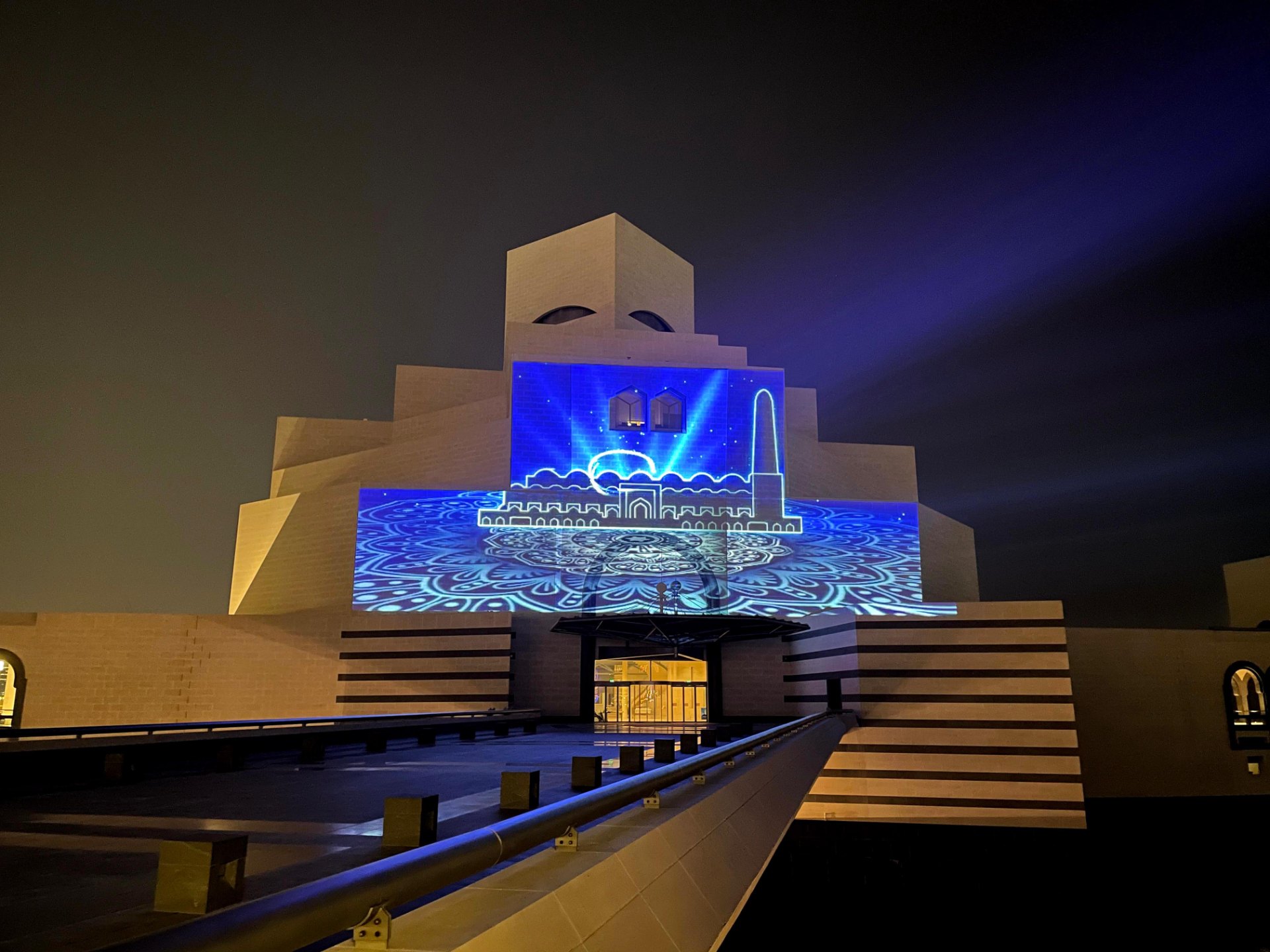
Museum of Islamic Art, Qatar Museums. A permanent outdoor façade projection, not a temporary event installed for one night and a teardown the next morning.
44 projectors, blended into a single canvas of 5760 × 2160. Media-server driven. Running year-round, outdoors, on one of the most recognisable buildings in the region, in the kind of heat, humidity and salt air that a coastal Gulf summer produces without apology.
The problem nobody briefs you on
Here's what almost every specification on a landmark building optimises for, whether anyone says it out loud or not: opening night.
Maximum brightness. Maximum resolution. The most impressive possible demo, timed for the ribbon-cutting and the photographs that go with it. It's an understandable instinct that's the night everyone's watching, and it's the moment the client, the press and the client's own board will judge the project by.
It's also the wrong brief.
A system engineered for launch night looks extraordinary in month one and degrades badly by month twelve, because it was built for a photograph, not for five years of Gulf summers. The brightest possible projector, in the tightest possible enclosure, chosen for the sharpest possible image on opening night, is very often the wrong projector for month fourteen when heat has been cycling through that enclosure daily, salt air has been settling on every seal and connector, and nobody has climbed up to check on it since the launch party ended.
Nobody claps for a projector that's still correctly aligned in year three. Nobody photographs the enclosure that's still sealed against the humidity. But everybody notices, eventually, when either one fails and by then it isn't a design decision anymore, it's an unplanned repair on a building where nothing is easy to reach.
What the environment actually dictated
Once the brief stopped being "make it as impressive as possible" and started being "make it work in this specific place, for years, without someone climbing up there every month," the decisions changed almost everywhere:
Optics were chosen for the throw distances the building actually allowed not the ones that would have produced a cleaner spec sheet on paper.
Enclosures were rated for heat and salt air, not the standard outdoor housing that would have been fine in a drier, cooler climate but wasn't built for this one.
Alignment was designed assuming the building and the mounting points would move over time, the way structures always do, rather than assuming they'd stay exactly where they were left on installation day.
Maintenance access was planned from the start, because a system nobody can safely reach to service is a system that will eventually fail quietly and stay failed.
None of these are the choices you'd make if the only question in the room was "what's the best possible projector for this job?" They're the choices you make when the real question is "what does this specific building, in this specific place, actually allow?"
The wider point
Every project has a constraint that outranks preference, whether anyone identifies it early or finds it out the hard way later.
On a coastal façade, it's weather. In a corporate office, it might be a ceiling void two inches shallower than the drawings suggested. It might be a meeting room that everyone insists is a boardroom but is actually used, most days, for two things it was never designed for a training room on Tuesdays, an overflow lunch space on Fridays. It might be a heritage building where you can't run a single new cable through a wall that matters more than the system you're installing.
The constraint is rarely dramatic. It's rarely the thing anyone puts at the top of the brief, because it doesn't sound like a design decision, it sounds like an inconvenience, or a footnote, or someone else's problem to sort out. But it's the thing that decides, quietly, which of your preferences you actually get to keep.
The projectors at Doha could have been chosen for image quality alone, and on a data sheet, some of the alternatives would have looked better. They weren't the right choice once the environment was treated as the actual client in the room, the thing the system had to satisfy first, before anyone's aesthetic preference got a vote.
What this means if you're planning a project
The instinct on any project worth doing well is to start with what you want the space to do. That's not wrong, it's just the second question, not the first.
The first question is what the environment already rules out, before anyone's preference gets a vote. Heat, salt air and building movement ruled out several options at Doha before a single projector was chosen. On a different project, it might be acoustics, or footfall, or a building services team that can service one kind of system but not another. Whatever it is, it exists whether or not it's named on day one the only choice is whether it gets found during design, or during a maintenance callout in year two.
Asking the question early is not a smaller version of the work. It usually is the work.
Closing
The site dictates the system. Environment is the first specification, not a constraint you work around after the fact.
The project referenced in this article was delivered by Parag Kothari in a senior systems integration role prior to AVYA's founding. It is shown as the delivery experience behind AVYA's independent consulting, not as an AVYA client engagement.